
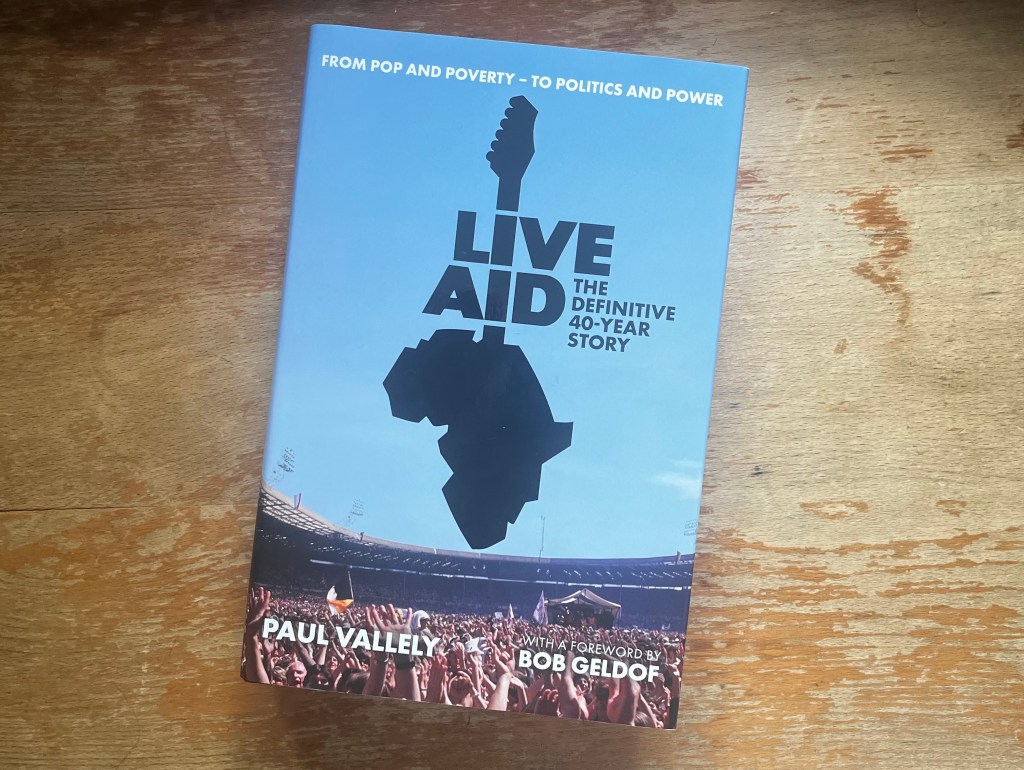
Paul Vallely, author of a doorstopper of a book, Philanthropy A to Z, was set to speak at Faversham Literary Festival recently, so I got myself a ticket. Only later did I realise he was speaking alongside Bob Geldof: turns out that Vallely has worked alongside the musician (and Faversham resident) for decades and has written a new book, Live Aid: The Definitive 40-Year Story.
The Band Aid Charitable Trust has spent more than £145 million on tackling poverty and hunger in Ethiopia and beyond. But Band Aid (the song, ‘Do they know it’s Christmas?’) and Live Aid (the concerts) have also faced some strong criticism since they made a splash in 1984/5 – above all for “portraying the entire continent as one monolithic, war-torn, starving place” and promoting “the patronising ‘save Africa’ industry”. This narrative has created long-term harm, opponents argue, citing potentially billions of dollars in higher interest payments on loans as a result of the whole continent being viewed as high risk.
Some still defend the project, saying it is hunger, not messaging, that “destroys dignity”. Either way, Band/Live Aid remains compelling for the extraordinary numbers it mobilised. Not just the 1.9 billion people who watched the concerts, but also all those behind the scenes, as Vallely writes:
“Everyone did their bit to maximise the amount it raised in the short space of time before Christmas Day… Phonogram’s factories pressed the record for free. ICI donated the vinyl…. The women who packaged the record sleeves agreed to work through the night, without pay, to get the first batch done. The delivery drivers who took the record to the shops worked unpaid.”
Musicians chipped in: another artist, in the running for a Christmas no. 1, suggested people buy the Band Aid record instead; others who weren’t part of the group donated the royalties from their hits instead. Everyone “felt good” about helping: Band Aid, it seemed, had “tapped into an underlying stream of altruism, which surfaced in direct reaction to the self-obsession which was coming to define the decade.”
Or, as one analysis at the time put it: it “made giving and caring fashionable”.
Replicating that groundswell of support – for a cause with which most people had no direct connection – feels less likely today, and not just because of the internet age.
At Faversham, Geldof did not hold back on his anger towards Elon Musk et al (“waving that pathetic hedge strimmer or whatever the fuck it was…”) as he boasted in 2025 that he was “feeding USAID to the woodchipper”. Musk’s actions have been devastating: the Lancet has estimated that the sudden pullback of the world’s largest donor will cause an additional 14 million deaths over the next few years. We are living through the “death of kindness”, Geldof concludes.
“Death of kindness” sounds extreme, but things have certainly changed – and yes, policymakers are partly to blame. When governments reduce aid, as many have done quite drastically, it doesn’t just affect their own budgets – it “reshapes expectations, social norms and perceptions of responsibility”, according to recent research by BOND, the UK network of development NGOs. BOND found that talking to citizens about government aid cuts doesn’t galvanise their generosity; instead it normalises those cuts. It suggests aid is not a priority.
Geldof and Vallely hope the book offers a “template” for a new generation to mobilise others and bring about change. That may not be as impossible as we think: the early 1980s were “unkind times”, too, Vallely said. People were preoccupied by the Cold War, not by starving people; and “there was a general cutting of aid… a whole climate which said: don’t do this, just as there is now”.
Whether that template can be adapted for today – an era that is much more attuned to the potentially harmful power dynamics of charity – is another question.
Top photo: Live 8 concert in Edinburgh, by Ricjl – English Wikipedia (CC BY-SA 2.5)
 How can we help
Leave a comment